
🚚 U.S. Nationwide CDL Fast-Track Program
A Modular Fast-Track CDL Path
- Accelerated CDL Schools (2–4 weeks)
- Paid CDL Training
- Company-Sponsored Pathways
New drivers can progress from permit to full CDL certification in a matter of weeks, followed by structured onboarding and employment opportunities.Availability varies by state, but candidates across the U.S. can access a realistic, efficient, and professionally recognized path into commercial driving.
⭐ 1|Introduction
Earning a Commercial Driver’s License (CDL) in the United States can be much faster than many people expect. Across the country, new drivers rely on a modular fast-track system made up of training schools, carrier training programs, and structured post-training routes.
No single institution provides every service in one place, yet drivers can create an efficient training route by combining several widely available components.
This guide covers:
- The three modules that form a realistic fast-track CDL path
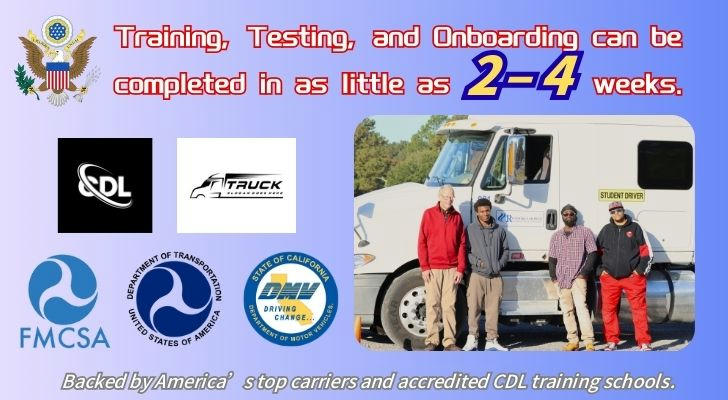
- How new drivers combine these modules to complete training in 2–4 weeks
- Which U.S. states provide the most accessible fast-track options
- Who benefits most from this approach
This resource is designed for beginners, career changers, and anyone seeking a clear, professional training route into the trucking industry.
2|How Fast CDL Pathways Work in the U.S.
The U.S. CDL training ecosystem operates through three independent but compatible modules. Most fast-track routes result from combining them.
This system allows new drivers to move smoothly from permit → training → testing → employment while maintaining compliance with federal and state requirements.
3|Module A:Accelerated CDL Training Schools (2–4 Weeks)
Accelerated CDL schools focus on short-duration, high-intensity training. These programs emphasize hands-on driving and exam preparation.
Common features include:
- 2–4 weeks of high-density behind-the-wheel sessions
- Daily backing, maneuvering, and on-road practice
- Pre-trip inspection training
- CDL-ready trucks provided for the state exam
- State-aligned curriculum and testing preparation
Typical student profile:
- Beginners seeking structure
- Individuals aiming for the shortest possible training period
- Students who want dedicated exam preparation
Accelerated programs are widely available in major urban centers, regional hubs, and areas with strong logistics demand.
4|Module B:Paid CDL Training (Compensated Training Period)
Paid CDL training is offered by large national carriers. Trainees receive income during training, followed by supervised on-the-road instruction.
Common characteristics:
- Compensation during the training period
- Mentorship with experienced commercial drivers
- Introduction to long-haul or regional routes
- Fleet-specific equipment training
- Structured progression from student driver to solo driver
Paid CDL training is often ideal for individuals who want training support while transitioning into the workforce.
5|Module C:Company-Sponsored CDL Training
In this pathway, carriers provide cost-supported training in exchange for completing designated driving routes after certification.
Common elements include:
- Training costs covered or supported by the carrier
- Structured onboarding after licensing
- Direct transition to company equipment and routes
- Opportunities in regional, dedicated, or long-haul divisions
This module reduces upfront expenses and provides predictable route placement upon completion.
6|Fast-Track CDL Programs at a Glance
| Company / School | Accelerated 2–4 Week Training | Sponsored CDL Training | Paid Apprenticeship | Local / Nationwide Campuses | Job Placement Support |
|---|---|---|---|---|---|
| Swift Transportation | ✅ Fast-track 2–4 weeks | ✅ Sponsored options | ✅ Paid apprentice program | ✅ Nationwide terminals | ✅ Direct fleet entry |
| Prime Inc. | ✅ Speedy track available | ✅ Sponsored CDL | ✅ Paid apprenticeship | ⚡ Some regions | ✅ Fleet placement |
| Roehl Transport | ✅ “Get Your CDL™” 2–4 weeks | ✅ Sponsored CDL | ✅ Paid apprenticeship | ✅ Multi-state campuses | ✅ Fleet entry |
| Schneider National | ✅ CAT / accelerated | ✅ Sponsored training | ✅ Paid apprenticeship | ✅ Multiple terminals | ✅ Direct assignment |
| Werner Enterprises | ⚡ Accelerated option depends on region | ✅ Sponsored programs | ✅ Paid apprenticeship | ✅ Multiple terminals | ✅ Fleet support |
| CR England | ✅ Premier school tracks | ✅ Sponsored CDL | ✅ Paid apprentice | ✅ Multi-state | ✅ Fleet entry |
| Roadmaster Drivers School | ✅ Accelerated school format | ⚡ Partnership dependent | ⚡ Depends on company | ✅ Multiple states | ⚡ Partner companies |
| 160 Driving Academy | ✅ Accelerated programs | ⚡ Depends on partner company | ⚡ Depends on company | ✅ 100+ campuses nationwide | ⚡ Partner companies |
| SAGE Truck Driving Schools | ✅ Accelerated tracks | ⚡ Some states | ⚡ Limited | ✅ Multiple campuses | ⚡ Partner companies |
✅ Legend / Quick Guide
- ✅ = Full support / clear pathway
- ⚡ = Partial support / conditional (depends on location or partner company)
7|Fast-Track CDL Timeline(Example: 2–4 Weeks)
| Week | Training Focus |
|---|---|
| Week 1 | CLP test prep · Written exam · Basic vehicle control |
| Week 2 | Backing practice · Pre-trip inspection · Intro road driving |
| Week 3 | Maneuvers refinement · Mock test · Exam scheduling |
| Week 4 | Road test · Onboarding · Begin paid supervised driving |
Individual timelines vary by state testing capacity and program structure.
8|States with Strong Fast-Track CDL Availability
- Texas — dense training coverage in Dallas / Houston / San Antonio, strong freight lanes
- California — large logistics hubs, plenty of accelerated programs
- Florida — active hiring for new drivers, multiple 2–4 week schools
- Illinois — strong presence of CDL campuses near Chicago
- Georgia — Atlanta metro offers paid training and sponsored routes
Availability depends on state licensing systems, carrier operations, and training capacity.
9|Who Benefits from a Fast-Track CDL Path?
Fast-track CDL options tend to work well for a wide range of age groups, especially:
Young adults (18–24) Individuals entering the workforce for the first time, including those beginning with intrastate routes (18–20) before shifting to interstate driving at 21.
Mid-career adults (25–40) People transitioning from retail, warehouse, hospitality, manufacturing, or other fields who want a faster, more stable career path.
Older adults (40–55+) Individuals seeking long-term, skill-based work with consistent demand. Many in this group value structured training, predictable earnings, and the ability to switch careers without starting from zero.
These groups often choose fast-track programs because the timeline is short, the learning structure is clear, and route placement opportunities begin almost immediately after licensing.
10|Frequently Asked Questions
How quickly can a CDL be obtained?
Most accelerated routes fall between 2–4 weeks, depending on state scheduling and training availability.
Is paid training common?
Yes. Multiple nationwide carriers provide compensated training phases for new drivers.
Do training programs guarantee employment?
Carriers and schools often offer job placement support, but employment depends on route availability and carrier requirements.
Is prior driving experience required?
No. These pathways are designed for entry-level drivers.
Are training locations available nationwide?
Training centers and carrier terminals exist in most U.S. regions, though availability varies by state.
Verified References
- Roadmaster Drivers School — CDL Training
- 160 Driving Academy — CDL Training Network
- SAGE Truck Driving Schools
- Prime Inc. — CDL Training Program
- Roehl Transport — Paid CDL Training
- Schneider — New Driver Training
- Swift Transportation — Training School
- Knight Transportation — Training
- Werner Enterprises — Driver Programs